Junior PMs think the job is writing docs. Mid-level PMs think the job is running process. Senior PMs know the job is making calls no one else can make.
Product management exists because somebody needs to be the advocate for the person paying. Not the engineering team, not the CEO, not sales — the customer. That is the entire profession in one line.
Everything else — the roadmaps, the PRDs, the sprint planning, the stakeholder management — is downstream of that one job. If you lose sight of it, you become a project manager with a fancier title.
The identity crisis
Before we define the role properly, let's look at what it feels like when nobody has defined it.
This is what week one looks like for most new PMs. Everyone needs something from you. All of it feels urgent. None of it tells you what your actual job is.
Your actual job is this: figure out which of these things matters most for the customer, and make a call. Not answer all of them. Not please everyone. Make a call.
The rest of this page teaches you how to think about that.
You're a new PM at a Series B fintech (Razorpay scale). Week 1. The CEO wants a strategy deck for the board next week. The sales lead wants you on a Reliance call Thursday. The engineering lead needs specs for an auth migration so sprint planning can start. You have five working days.
The call: What do you prioritize in week 1, and how do you communicate your choice to the others without burning relationships?
Your reasoning
You're a new PM at a Series B fintech (Razorpay scale). Week 1. The CEO wants a strategy deck for the board next week. The sales lead wants you on a Reliance call Thursday. The engineering lead needs specs for an auth migration so sprint planning can start. You have five working days.
Your task
What do you prioritize in week 1, and how do you communicate your choice to the others without burning relationships?
Your reasoning
Product is the carrier of value
Before we talk about the manager, let's define the thing being managed.
A product is the carrier of value that customers pay for directly. Not the Android app. Not the Chrome extension. Not the hardware. Those are delivery mechanisms. The product is the value itself.
Instagram is a product. Image feed, filters, stories, reels — those are features. Users pay Instagram via their attention by using image feed. That attention is the currency.
But here is where it gets confusing. Inside Instagram, the image feed team has its own product manager. The ads team has its own product manager. The communication hub has its own product manager. Each feature became individually valuable and complex enough to need a dedicated person. Internally, each one is called a "product."
This is not a contradiction. It is a consequence of scale. When a product grows, its subsystems become individually valuable. Each subsystem needs someone who deeply understands its users, its constraints, and its direction.
The value of the whole product is the sum total of value delivered by its subsystems — plus the value of how they are assembled. Apple understood this decades ago. Some products have identical components and wildly different outcomes because of how they are packaged.
Three levels of product
Philip Kotler framed products in three concentric layers. This is one of the few MBA frameworks that actually holds up in practice:
| Level | What it is | Washing machine example | Instagram example |
|---|---|---|---|
| Core product | The benefit users actually pay for | Convenience — clean clothes without effort | Social validation via visual sharing |
| Actual product | The physical/digital thing that delivers it | Drums, heater, motor, controls | The app — feed, filters, camera, stories |
| Augmented product | Everything around it that supports the experience | Warranty, installation, customer service | Creator tools, analytics, help center |
When you strip a product to its core, you find the job the customer is actually hiring it for. Everything else is packaging. Good PMs think about all three layers. Great PMs know which layer to invest in at which stage.
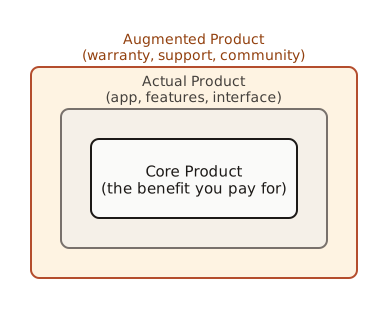
Pick a product you use every day — Swiggy, Spotify, Google Pay, whatever. Write down:
- Core product — what benefit are you actually paying for (with money or attention)?
- Actual product — what are the specific features that deliver that benefit?
- Augmented product — what wraps around it (support, community, integrations)?
If you can't separate them cleanly, try a simpler product — a local chai stall. What's the core value? What's the actual delivery? What's the augmented experience? Now go back to the digital product.
What a PM actually does
The job has three parts:
1. Decide what to build. Not what the CEO wants. Not what the loudest customer asked for. What will create the most value for the most users, given the constraints you have. This requires talking to users, reading data, understanding the market, and having a point of view.
2. Get it built. You don't write code. You don't push pixels. You align the people who do — engineering, design, QA, data — around a shared understanding of the problem and the solution. You remove ambiguity. You make trade-offs. You unblock.
3. Make sure it works. Ship is not the finish line. Did the feature actually change the metric you predicted? Did users adopt it? Did it create the value you promised? If not, what did you learn and what changes next?
That is it. Everything else is a sub-skill in service of these three responsibilities.
"Aren't you basically a project manager?"
This conversation happens in every traditional Indian IT company. Let's watch it play out.
Sprint planning. A services company transitioning to product.
Suresh (Delivery Manager): “So I've listed the client requirements in the tracker. Can you break them into tasks and assign to the dev team?”
You (New PM): “Before we assign anything — which of these requirements actually solve a user problem? Have we validated any of them?”
Suresh (Delivery Manager): “The client asked for them. That's the validation.”
Two developers exchange a look. This is new.
You (New PM): “The client asked for a dashboard with 47 metrics. But when I spoke with their ops team last week, they only look at 3. Can we ship those 3 well instead of 47 badly?”
Suresh (Delivery Manager): “...that's not how we've done things here.”
This is the moment where product management either takes root in a company, or gets reduced to project management with a nicer title.
The difference between PM and project management is one question: 'Should we build this at all?'
Most confusion about the PM role stems from these overlaps:
| Role | How it differs from PM |
|---|---|
| Project Manager | Manages timelines, dependencies, and delivery. Does not decide what to build — manages the how and when. A PM without opinions about what to build has become a project manager. |
| Product Owner | An Agile role focused on backlog management and sprint execution. In many companies, PO and PM are the same person. In others, PO handles the sprint-level detail while PM handles the quarter-level strategy. The boundary depends on team size. |
| Business Analyst | Translates business requirements into specs. A BA documents what stakeholders want. A PM pushes back on what stakeholders want when it conflicts with what users need. |
| UX Designer | Owns the interaction, information architecture, and visual design. PMs partner closely with designers — but the PM's job is to define the problem. The designer's job is to solve it in the interface. |
| Engineering Manager | Manages the engineering team — people, processes, technical architecture. The PM says what and why. The EM says how and who. Overlap exists, but the accountability split is clean. |
| Program Manager (TPM) | Coordinates across multiple teams and workstreams. In large companies (Google, Amazon), TPMs manage the cross-team execution that a single PM cannot. |
The cleanest way to think about it: the PM is responsible for the value delivered. The project manager is responsible for the delivery plan. The engineering manager is responsible for the people who build it.

The "mini-CEO" myth
You will hear people call PMs "the CEO of the product." This is misleading.
A CEO has authority. A PM has influence. A CEO can fire people, set budgets, change strategy unilaterally. A PM can do none of these things. The PM has to convince engineering to build, convince design to prioritize, convince leadership to fund — all without positional authority.
This is actually what makes the role hard. You are accountable for outcomes you do not fully control. You ship through other people's hands.
The more accurate description: a PM is the person in the room who cares most about the customer's problem and has enough context about business, technology, and design to make good trade-offs.
If you are comfortable with ambiguity, enjoy working across functions, and can handle being responsible for outcomes without controlling the inputs — you will thrive. If you need authority to get things done, the role will frustrate you.
The Drive Test: what kind of company are you at?
Before worrying about PM types, answer a more fundamental question: is your company business-driven or product-driven?
| Business-driven | Product-driven | |
|---|---|---|
| Who decides what gets built? | Sales, operations, or the founder | The product team, informed by data and users |
| PM authority | Low — you execute what the business needs | High — you shape what the product becomes |
| Strategy flow | Top-down from revenue targets | Bottom-up from user problems |
| Indian examples | Ola, OYO, WeWork India | Postman, BrowserStack, CleverTap, Zerodha |
| Your primary skill | Stakeholder management, business translation | User research, experimentation, product vision |
Most Indian startups start business-driven (founder-led, sales-heavy) and graduate to product-driven as they mature. Knowing where your company sits on this spectrum tells you what kind of PM work you will actually do — regardless of what the job description says.
Types of PM roles
Not all PM roles are the same. The daily work varies significantly depending on the product type:
| PM type | What changes | Key skill emphasis |
|---|---|---|
| B2C PM | High-volume users, speed of iteration, analytics-heavy. You A/B test everything. User research is quantitative + qualitative. | Funnel analytics, experimentation, UX intuition |
| B2B PM | Fewer customers, higher stakes per deal. Sales team is a major stakeholder. Feedback comes from account managers, not just data. | Stakeholder management, enterprise workflows, pricing |
| Platform PM | Your users are other teams or developers. You build infrastructure, APIs, SDKs. | Technical depth, developer experience, system thinking |
| Growth PM | Focused on acquisition, activation, retention. You own the funnel, not the product. | Experimentation, data analysis, conversion psychology |
| Data PM | Building data products — pipelines, dashboards, ML features. You need to speak data engineering and data science. | SQL, data architecture, ML fundamentals |
| Technical PM | Deep in a specific technical domain — payments, security, infra. Expected to have domain expertise beyond general PM skills. | Domain technical knowledge, system design |
| AI PM | Building AI-powered features or products. You need to understand what models can and cannot do. See AI for PMs. | Prompt design, evaluation, ML product lifecycle |
The titles vary across companies. Some places call B2B PMs "Product Owners." Some call Platform PMs "Technical Product Managers." The title matters less than understanding which of these you are actually doing — because the skills and the stakeholders are different.
In India specifically, B2B PM roles are growing faster than B2C. The startup ecosystem has matured past the consumer-app-for-everything phase. Enterprise SaaS, fintech infrastructure, healthtech — these are the sectors hiring.
The profession is younger than you think
Product management as a distinct role barely existed in India before 2015. Most tech companies had project managers. The ones that had PMs borrowed the Silicon Valley playbook without adapting it.
The profession has gone through three waves:
Wave 1 (pre-2015): Project managers with product titles. The job was mostly coordination — take requirements from business, write them up, hand them to engineering, track the timeline. No user research. No data analysis. No strategy.
Wave 2 (2015-2021): The PM gold rush. Startups raised massive rounds. PM roles exploded. Everyone wanted to be a PM. Bootcamps appeared. PM became the "cool" career switch from engineering and MBA. The problem: many of these roles were glorified project management with PM titles.
Wave 3 (2022-now): The correction. Layoffs hit PMs hard. Junior PM roles are down 40% from 2022. Senior PM roles are down 15%. The market is separating PMs who own outcomes from PMs who push tickets. AI is accelerating this — the coordination and documentation work that filled a junior PM's day is getting automated.
What survives is the core: deciding what to build, making trade-offs, owning outcomes. If that is what excites you, the profession is not shrinking — it is sharpening.
Test yourself: the roadmap ambush
You've read the theory. Now let's see how you'd handle a real situation.
You're two months into your PM role at a B2B SaaS startup. You've spent three weeks on user research and built a roadmap focused on fixing onboarding drop-off — your biggest churn driver. Monday morning, product review meeting.
Your CEO walks in and says: "I spoke with the Jio team over the weekend. They need SSO by March. Move it to P0. They're 40% of our ARR." The room goes quiet. Your engineering lead is looking at you.
PL alumni now work at Flipkart, Google, Razorpay, PhonePe, Swiggy, Amazon, Microsoft, and 30+ other companies.
Where this manual goes from here
This page gave you the foundation: what product management is, what it is not, how the role varies, and where the profession stands. The rest of the manual builds on this.
- If you think in first principles and want to develop the PM mindset: Product Thinking
- If you want to self-assess your PM skills: The PM Competency Model
- If you want to know what the career trajectory looks like: The PM Career Ladder
- If you are trying to break into the role: Breaking Into PM
- If you are preparing for interviews right now: PM Interviews